Reference Architecture with Terraform: Cloud NGFW in Azure, Distributed Design Model.
Palo Alto Networks produces several validated reference architecture design and deployment documentation guides, which describe well-architected and tested deployments. When deploying Cloud NGFWs in a public cloud, the reference architecturesguide users toward the best security outcomes, whilst reducing rollout time and avoiding common integration efforts.
The Terraform code presented here will deploy Palo Alto Networks Cloud NGFW firewall in Azure based on a distributed virtual network design model with common Cloud NGFW for all traffic; for a discussion of other options, please see the design guide from the reference architecture guides.


Detailed Architecture and Design
Distributed Virtual Network Design
This code implements:
- a distributed virtual network design, a distributed topology where each VNet contains a separate Cloud NGFW to inspect all inbound, outbound, east-west, and enterprise traffic.
Application functions and resources are deployed across multiple VNets that are not connected with each other by any means. You integrate a separate Cloud NGFW with each VNet, handling all types of traffic for this specific VNet. Please see the Cloud NGFW design guide.
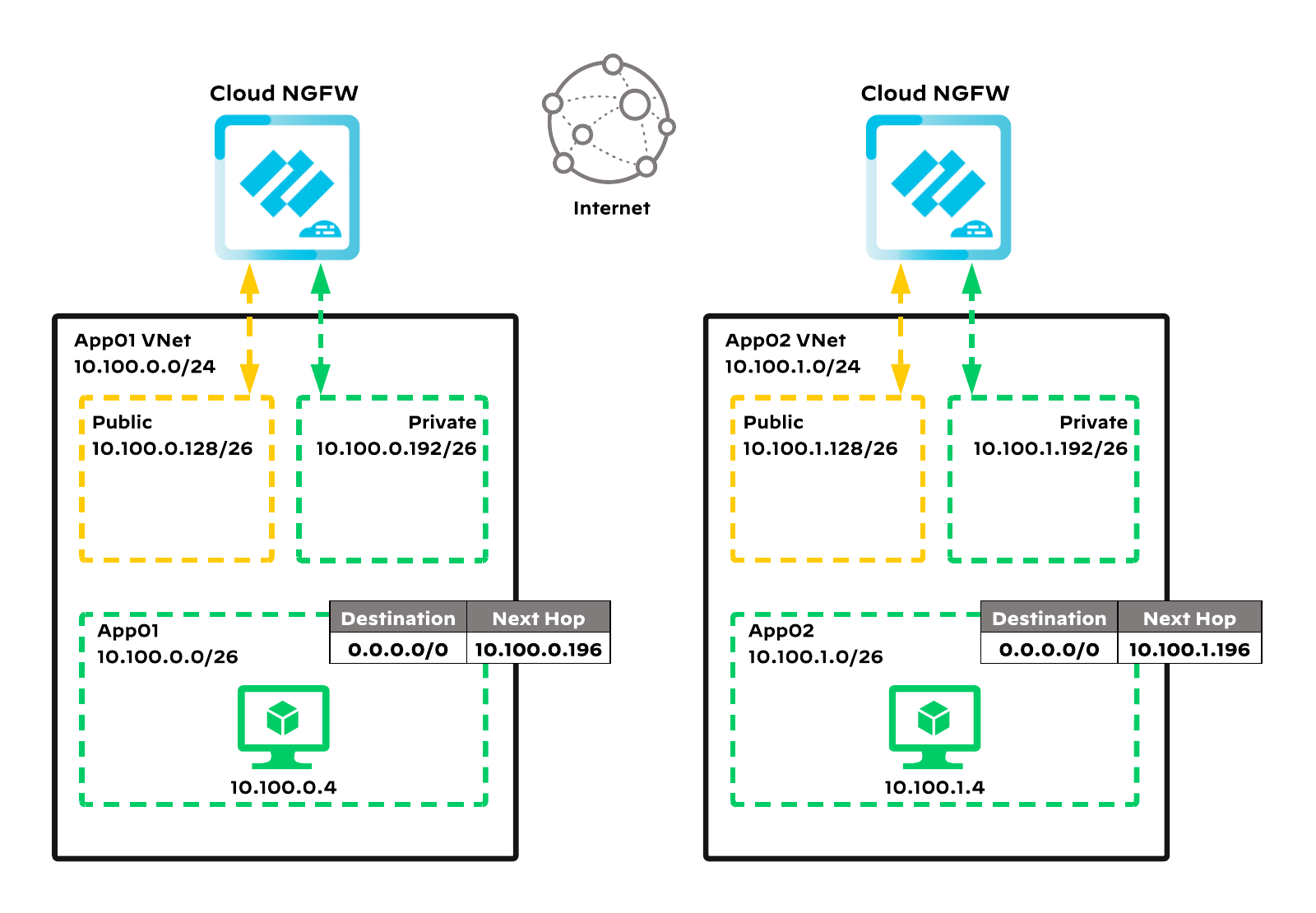
This reference architecture consists of:
- 2 Cloud NGFW, each:
- with 2 network interfaces: public, private
- with 2 public IP addresses assigned to public interface
- Destination Network Address Translation rules
- test workloads with accompanying infrastructure:
- 2 Spoke VNETs with Cloud NGFW dedicated Subnets (private and public), Route Tables and Network Security Groups
- 2 Spoke VMs serving as WordPress-based web servers
- 2 Azure Bastion managed jump hosts
Prerequisites
A list of requirements might vary depending on the platform used to deploy the infrastructure but a minimum one includes:
- (in case of non cloud shell deployment) credentials and (optionally) tools required to authenticate against Azure Cloud, see AzureRM provider documentation for details
- supported version of
Terraform
NOTE!
- after the deployment the firewalls remain not configured and not licensed
- to manage Cloud NGFW via Panorama, an existing Panorama instance is required. Please see the Panorama integration guide.
Usage
Deployment Steps
-
checkout the code locally (if you haven't done so yet)
-
copy the
example.tfvarsfile, rename it toterraform.tfvarsand adjust it to your needs (take a closer look at theTODOmarkers) -
(optional) authenticate to AzureRM, switch to the Subscription of your choice
-
provide
subscription_ideither by creating an environment variable namedARM_SUBSCRIPTION_IDwith Subscription ID as value in your shell (recommended option) or by setting the value ofsubscription_idvariable within yourtfvarsfile (discouraged option, we don't recommend putting the Subscription ID in clear text inside the code). -
initialize the Terraform module:
terraform init -
(optional) plan you infrastructure to see what will be actually deployed:
terraform plan -
deploy the infrastructure (you will have to confirm it with typing in
yes):terraform applyThe deployment takes couple of minutes.
Post deploy
Firewall in this example is configured for management via Panorama. To manage the firewall, all configurations are handled through the Panorama instance.
Cleanup
To remove the deployed infrastructure run:
terraform destroy
Reference
Requirements
terraform, version: >= 1.5, < 2.0
Providers
randomazurerm
Modules
| Name | Version | Source | Description |
|---|---|---|---|
vnet | - | ../../modules/vnet | |
vnet_peering | - | ../../modules/vnet_peering | |
public_ip | - | ../../modules/public_ip | |
virtual_wan | - | ../../modules/vwan | |
vwan_routes | - | ../../modules/vwan_routes | |
cloudngfw | - | ../../modules/cloudngfw | |
test_infrastructure | - | ../../modules/test_infrastructure |
Resources
resource_group(managed)password(managed)resource_group(data)
Required Inputs
| Name | Type | Description |
|---|---|---|
subscription_id | string | Azure Subscription ID is a required argument since AzureRM provider v4. |
resource_group_name | string | Name of the Resource Group. |
region | string | The Azure region to use. |
vnets | map | A map defining VNETs. |
cloudngfws | map | A map of objects defining the configuration for Cloud Next-Gen Firewalls (cloudngfws) in the environment. |
Optional Inputs
| Name | Type | Description |
|---|---|---|
name_prefix | string | A prefix that will be added to all created resources. |
create_resource_group | bool | When set to true it will cause a Resource Group creation. |
tags | map | Map of tags to assign to the created resources. |
vnet_peerings | map | A map defining VNET peerings. |
public_ips | object | A map defining Public IP Addresses and Prefixes. |
virtual_wans | map | A map defining Virtual WANs. |
test_infrastructure | map | A map defining test infrastructure including test VMs and Azure Bastion hosts. |
Outputs
| Name | Description |
|---|---|
test_vms_usernames | Initial administrative username to use for test VMs. |
test_vms_passwords | Initial administrative password to use for test VMs. |
test_vms_ips | IP Addresses of the test VMs. |
test_lb_frontend_ips | IP Addresses of the test load balancers. |
Required Inputs details
subscription_id
Azure Subscription ID is a required argument since AzureRM provider v4.
Note!
Instead of putting the Subscription ID directly in the code, it's recommended to use an environment variable. Create an
environment variable named ARM_SUBSCRIPTION_ID with your Subscription ID as value and leave this variable set to null.
Type: string
resource_group_name
Name of the Resource Group.
Type: string
region
The Azure region to use.
Type: string
vnets
A map defining VNETs.
For detailed documentation on each property refer to module documentation
create_virtual_network- (bool, optional, defaults totrue) when set totruewill create a VNET,falsewill source an existing VNET.name- (string, required) a name of a VNET. In casecreate_virtual_network = falsethis should be a full resource name, including prefixes.resource_group_name- (string, optional, defaults to current RG) a name of an existing Resource Group in which the VNET will reside or is sourced from.address_space- (list, required whencreate_virtual_network = false) a list of CIDRs for a newly created VNET.dns_servers- (list, optional, defaults to module defaults) a list of IP addresses of custom DNS servers (by default Azure DNS is used).vnet_encryption- (string, optional, defaults to module default) enables Azure Virtual Network Encryption when set, only possible value at the moment isAllowUnencrypted. When set tonull, the feature is disabled.ddos_protection_plan_id- (string, optional, defaults tonull) ID of an existing Azure Network DDOS Protection Plan to be associated with the VNET.network_security_groups- (map, optional) map of Network Security Groups to create, for details see VNET module documentation.route_tables- (map, optional) map of Route Tables to create, for details see VNET module documentation.subnets- (map, optional) map of Subnets to create or source, for details see VNET module documentation.
Type:
map(object({
    create_virtual_network  = optional(bool, true)
    name                    = string
    resource_group_name     = optional(string)
    address_space           = optional(list(string))
    dns_servers             = optional(list(string))
    vnet_encryption         = optional(string)
    ddos_protection_plan_id = optional(string)
    network_security_groups = optional(map(object({
      name = string
      rules = optional(map(object({
        name                         = string
        priority                     = number
        direction                    = string
        access                       = string
        protocol                     = string
        source_port_range            = optional(string)
        source_port_ranges           = optional(list(string))
        destination_port_range       = optional(string)
        destination_port_ranges      = optional(list(string))
        source_address_prefix        = optional(string)
        source_address_prefixes      = optional(list(string))
        destination_address_prefix   = optional(string)
        destination_address_prefixes = optional(list(string))
      })), {})
    })), {})
    route_tables = optional(map(object({
      name                          = string
      bgp_route_propagation_enabled = optional(bool)
      routes = map(object({
        name                = string
        address_prefix      = string
        next_hop_type       = string
        next_hop_ip_address = optional(string)
      }))
    })), {})
    subnets = optional(map(object({
      create                          = optional(bool, true)
      name                            = string
      address_prefixes                = optional(list(string), [])
      network_security_group_key      = optional(string)
      route_table_key                 = optional(string)
      default_outbound_access_enabled = optional(bool)
      enable_storage_service_endpoint = optional(bool)
      enable_appgw_delegation         = optional(bool)
      enable_cloudngfw_delegation     = optional(bool)
    })), {})
  }))
cloudngfws
A map of objects defining the configuration for Cloud Next-Gen Firewalls (cloudngfws) in the environment.
Each cloudngfw entry in the map supports the following attributes:
-
name- (string, required) the name of the Palo Alto Next Generation Firewall instance. -
attachment_type- (string, required) specifies whether the firewall is attached to a Virtual Network (vnet) or a Virtual WAN (vwan). -
virtual_network_key- (string, optional) key referencing the Virtual Network associated with this firewall. Required if theattachment_typeisvnet. -
untrusted_subnet_key- (string, optional) key of the subnet designated as untrusted within the Virtual Network. -
trusted_subnet_key- (string, optional) key of the subnet designated as trusted within the Virtual Network. -
virtual_wan_key- (string, optional) key of the Virtual Wan where to place the Cloud NGFW. -
virtual_hub_key- (string, optional) key of the Virtual Hub within a vWAN where to place the Cloud NGFW. -
management_mode- (string, required) defines the management mode for the firewall. When set topanorama, the firewall's policies are managed via Panorama. -
cloudngfw_config- (object, required) configuration details for the Cloud NGFW instance, with the following properties:-
panorama_base64_config- (string, optional) the Base64-encoded configuration for connecting to Panorama server. This field is required whenmanagement_modeis set topanorama. -
rulestack_id- (string, optional) the ID of the Local Rulestack used to configure this Firewall Resource. This field is required whenmanagement_modeis set torulestack. -
create_public_ip- (bool, optional, defaults totrue) controls if the Public IP resource is created or sourced. This field is ignored when the variablepublic_ip_keysis used. -
public_ip_name- (string, optional) the name of the Public IP resource. This field is required unless the variablepublic_ip_keysis used. -
public_ip_resource_group_name- (string, optional) the name of the Resource Group hosting the Public IP resource. This is used only for sourced resources. -
public_ip_keys- (list, optional) the keys referencing Public IP addresses frompublic_ipmodule. Property is used when Public IP is not created or sourced withincloudngfwmodule. -
egress_nat_ip_keys- (list, optional) the keys referencing egress NAT Public IP addresses frompublic_ipmodule. Property is used when Public IP is not created or sourced withincloudngfwmodule. -
trusted_address_ranges- (list, optional) a list of public IP address ranges that will be treated as internal traffic by Cloud NGFW in addition to RFC 1918 private subnets. Each list entry has to be in a CIDR format. -
destination_nats- (map, optional) defines one or more destination NAT configurations. Each object supports the following properties:destination_nat_name- (string, required) the name of the Destination NAT. Must be unique within this map.destination_nat_protocol- (string, required) the protocol for this Destination NAT. Possible values areTCPorUDP.frontend_public_ip_key- (string, optional) the key referencing the Public IP that receives the traffic. This is used only when the variablepublic_ip_idsis utilized.frontend_port- (number, required) the port on which traffic will be received. Must be in the range from 1 to 65535.backend_ip_address- (string, required) the IPv4 address to which traffic will be forwarded.backend_port- (number, required) the port number to which traffic will be sent. Must be in the range 1 to 65535.
-
Type:
map(object({
    name                 = string
    attachment_type      = string
    virtual_network_key  = optional(string)
    untrusted_subnet_key = optional(string)
    trusted_subnet_key   = optional(string)
    virtual_wan_key      = optional(string)
    virtual_hub_key      = optional(string)
    management_mode      = string
    cloudngfw_config = object({
      plan_id                       = optional(string)
      marketplace_offer_id          = optional(string)
      panorama_base64_config        = optional(string)
      rulestack_id                  = optional(string)
      create_public_ip              = optional(bool, true)
      public_ip_name                = optional(string)
      public_ip_resource_group_name = optional(string)
      public_ip_keys                = optional(list(string))
      egress_nat_ip_keys            = optional(list(string))
      trusted_address_ranges        = optional(list(string))
      destination_nats = optional(map(object({
        destination_nat_name     = string
        destination_nat_protocol = string
        frontend_public_ip_key   = optional(string)
        frontend_port            = number
        backend_ip_address       = string
        backend_port             = number
      })), {})
    })
  }))
Optional Inputs details
name_prefix
A prefix that will be added to all created resources. There is no default delimiter applied between the prefix and the resource name. Please include the delimiter in the actual prefix.
Example:
name_prefix = "test-"
Note!
This prefix is not applied to existing resources. If you plan to reuse i.e. a VNET please specify it's full name,
even if it is also prefixed with the same value as the one in this property.
Type: string
Default value: ``
create_resource_group
When set to true it will cause a Resource Group creation.
Name of the newly specified RG is controlled by resource_group_name.
When set to false the resource_group_name parameter is used to specify a name of an existing Resource Group.
Type: bool
Default value: true
tags
Map of tags to assign to the created resources.
Type: map(string)
Default value: map[]
vnet_peerings
A map defining VNET peerings.
Following properties are supported:
local_vnet_name- (string, required) name of the local VNET.local_resource_group_name- (string, optional) name of the resource group, in which local VNET exists.remote_vnet_name- (string, required) name of the remote VNET.remote_resource_group_name- (string, optional) name of the resource group, in which remote VNET exists.
Type:
map(object({
    local_vnet_name            = string
    local_resource_group_name  = optional(string)
    remote_vnet_name           = string
    remote_resource_group_name = optional(string)
  }))
Default value: map[]
public_ips
A map defining Public IP Addresses and Prefixes.
Following properties are available:
public_ip_addresses- (map, optional) map of objects describing Public IP Addresses, please refer to module documentation for available properties.public_ip_prefixes- (map, optional) map of objects describing Public IP Prefixes, please refer to module documentation for available properties.
Type:
object({
    public_ip_addresses = optional(map(object({
      create                     = bool
      name                       = string
      resource_group_name        = optional(string)
      zones                      = optional(list(string))
      domain_name_label          = optional(string)
      idle_timeout_in_minutes    = optional(number)
      prefix_name                = optional(string)
      prefix_resource_group_name = optional(string)
      prefix_id                  = optional(string)
    })), {})
    public_ip_prefixes = optional(map(object({
      create              = bool
      name                = string
      resource_group_name = optional(string)
      zones               = optional(list(string))
      length              = optional(number)
    })), {})
  })
Default value: map[]
virtual_wans
A map defining Virtual WANs.
For detailed documentation on each property refer to module documentation
create- (bool, optional, defaults totrue) when set totruewill create a new Virtual WAN,falsewill source an existing Virtual WAN.name- (string, required) a name of a Virtual WAN. In casecreate = falsethis should be a full resource name, including prefixes.resource_group_name- (string, optional, defaults to current RG) a name of an existing Resource Group in which the Virtual WAN will reside or is sourced from.disable_vpn_encryption- (bool, optional, defaults tofalse) iftrue, VPN encryption is disabled.allow_branch_to_branch_traffic- (bool, optional, defaults totrue) iffalse, branch-to-branch traffic is not allowed.virtual_hubs- (map, optional) map of Virtual Hubs to create or source, for details see Virtual WAN module documentation.
Type:
map(object({
    name                           = string
    resource_group_name            = optional(string)
    create                         = optional(bool, true)
    region                         = optional(string)
    disable_vpn_encryption         = optional(bool, false)
    allow_branch_to_branch_traffic = optional(bool, true)
    virtual_hubs = optional(map(object({
      name                                   = string
      address_prefix                         = string
      create                                 = optional(bool, true)
      resource_group_name                    = optional(string)
      region                                 = optional(string)
      hub_routing_preference                 = optional(string)
      virtual_router_auto_scale_min_capacity = optional(number)
      connections = optional(map(object({
        name                       = string
        connection_type            = string
        remote_virtual_network_key = optional(string)
        vpn_site_key               = optional(string)
        vpn_link = optional(list(object({
          vpn_link_name                  = string
          vpn_site_link_key              = string
          bandwidth_mbps                 = optional(number)
          bgp_enabled                    = optional(bool)
          connection_mode                = optional(string)
          protocol                       = optional(string)
          ratelimit_enabled              = optional(bool)
          shared_key                     = optional(string)
          local_azure_ip_address_enabled = optional(bool)
          ipsec_policy = optional(object({
            dh_group                 = optional(string)
            ike_encryption_algorithm = optional(string)
            ike_integrity_algorithm  = optional(string)
            encryption_algorithm     = optional(string)
            integrity_algorithm      = optional(string)
            pfs_group                = optional(string)
            sa_data_size_kb          = optional(number)
            sa_lifetime_sec          = optional(number)
          }))
        })))
        routing = optional(object({
          associated_route_table_key                = optional(string)
          propagated_route_table_keys               = optional(list(string))
          propagated_route_table_labels             = optional(set(string))
          static_vnet_route_name                    = optional(string)
          static_vnet_route_address_prefixes        = optional(set(string))
          static_vnet_route_next_hop_ip_address     = optional(string)
          static_vnet_local_route_override_criteria = optional(string)
        }))
      })), {})
      route_tables = optional(map(object({
        name   = string
        labels = optional(set(string))
        routes = optional(map(object({
          name              = string
          destinations_type = string
          destinations      = list(string)
          next_hop_type     = optional(string)
          next_hop_key      = string
        })), {})
      })), {})
      routing_intent = optional(object({
        routing_intent_name = string
        routing_policy = list(object({
          routing_policy_name = string
          destinations        = list(string)
          next_hop_key        = string
        }))
      }))
      vpn_gateway = optional(object({
        name                = string
        resource_group_name = optional(string)
        scale_unit          = optional(number)
        routing_preference  = optional(string)
      }), null)
      vpn_sites = optional(map(object({
        name                = string
        region              = optional(string)
        resource_group_name = optional(string)
        address_cidrs       = optional(set(string))
        link = optional(map(object({
          name          = string
          ip_address    = optional(string)
          fqdn          = optional(string)
          provider_name = optional(string)
          speed_in_mbps = optional(number, 0)
        })))
      })), {})
    })), {})
  }))
Default value: map[]
test_infrastructure
A map defining test infrastructure including test VMs and Azure Bastion hosts.
For details and defaults for available options please refer to the
test_infrastructure module.
Following properties are supported:
-
create_resource_group- (bool, optional, defaults totrue) when set totrue, a new Resource Group is created. When set tofalse, an existing Resource Group is sourced. -
resource_group_name- (string, optional) name of the Resource Group to be created or sourced. -
vnets- (map, required) a map defining VNETs and peerings for the test environment. The most basic properties are as follows:create_virtual_network- (bool, optional, defaults totrue) when set totruewill create a VNET,falsewill source an existing VNET.name- (string, required) a name of a VNET. In casecreate_virtual_network =false` this should be a full resource name, including prefixes.address_space- (list(string), required whencreate_virtual_network =false`) a list of CIDRs for a newly created VNET.network_security_groups- (map, optional) map of Network Security Groups to create, for details see VNET module documentation.route_tables- (map, optional) map of Route Tables to create, for details see VNET module documentation.subnets- (map, optional) map of Subnets to create or source, for details see VNET module documentation.local_peer_config- (map, optional) a map that contains local peer configuration parameters. This value allows to setallow_virtual_network_access,allow_forwarded_traffic,allow_gateway_transitanduse_remote_gatewaysparameters on the local VNet peering.remote_peer_config- (map, optional) a map that contains remote peer configuration parameters. This value allows to setallow_virtual_network_access,allow_forwarded_traffic,allow_gateway_transitanduse_remote_gatewaysparameters on the remote VNet peering.
For all properties and their default values see module's documentation.
-
load_balancers- (map, optional) a map containing configuration for all (both private and public) Load Balancers. The most basic properties are as follows:name- (string, required) a name of the Load Balancer.vnet_key- (string, optional, defaults tonull) a key pointing to a VNET definition in thevar.vnetsmap that stores the Subnet described bysubnet_key.zones- (list, optional, defaults to ["1", "2", "3"]) a list of zones for Load Balancer's frontend IP configurations.backend_name- (string, optional) a name of the backend pool to create.health_probes- (map, optional, defaults tonull) a map defining health probes that will be used by load balancing rules, please refer to loadbalancer module documentation for more specific use cases and available properties.nsg_auto_rules_settings- (map, optional, defaults tonull) a map defining a location of an existing NSG rule that will be populated withAllowrules for each load balancing rule (in_rules), please refer to loadbalancer module documentation for available properties.
Please note that in this example two additional properties are available:
-
nsg_vnet_key- (string, optional, mutually exclusive withnsg_name) a key pointing to a VNET definition in thevar.vnetsmap that stores the NSG described bynsg_key. -
nsg_key- (string, optional, mutually exclusive withnsg_name) a key pointing to an NSG definition in thevar.vnetsmap. -
frontend_ips- (map, optional, defaults to{}) a map containing frontend IP configuration with respectivein_rulesandout_rules, please refer to loadbalancer module documentation for available properties.Note!
In this example thesubnet_idis not available directly, another property has been introduced instead:subnet_key- (string, optional, defaults tonull) a key pointing to a Subnet definition in thevar.vnetsmap.
For all properties and their default values see module's documentation.
-
authentication- (map, optional, defaults to example defaults) authentication settings for the deployed VMs. -
spoke_vms- (map, required) a map defining test VMs. The most basic properties are as follows:name- (string, required) a name of the VM.vnet_key- (string, required) a key describing a VNET defined invnetsproperty.subnet_key- (string, required) a key describing a Subnet found in a VNET definition.load_balancer_key- (string, optional) a key describing a Load Balancer defined inload_balancersproperty.
For all properties and their default values see module's documentation.
-
bastions- (map, required) a map containing Azure Bastion definitions. The most basic properties are as follows:name- (string, required) an Azure Bastion name.vnet_key- (string, required) a key describing a VNET defined invnetsproperty. This VNET should already have an existing subnet calledAzureBastionSubnet(the name is hardcoded by Microsoft).subnet_key- (string, required) a key pointing to a Subnet dedicated to a Bastion deployment.
For all properties and their default values see module's documentation.
Type:
map(object({
    create_resource_group = optional(bool, true)
    resource_group_name   = optional(string)
    vnets = map(object({
      create_virtual_network  = optional(bool, true)
      name                    = string
      address_space           = optional(list(string))
      dns_servers             = optional(list(string))
      vnet_encryption         = optional(string)
      ddos_protection_plan_id = optional(string)
      hub_vnet_key            = optional(string)
      network_security_groups = optional(map(object({
        name = string
        rules = optional(map(object({
          name                         = string
          priority                     = number
          direction                    = string
          access                       = string
          protocol                     = string
          source_port_range            = optional(string)
          source_port_ranges           = optional(list(string))
          destination_port_range       = optional(string)
          destination_port_ranges      = optional(list(string))
          source_address_prefix        = optional(string)
          source_address_prefixes      = optional(list(string))
          destination_address_prefix   = optional(string)
          destination_address_prefixes = optional(list(string))
        })), {})
      })), {})
      route_tables = optional(map(object({
        name                          = string
        bgp_route_propagation_enabled = optional(bool)
        routes = map(object({
          name                = string
          address_prefix      = string
          next_hop_type       = string
          next_hop_ip_address = optional(string)
        }))
      })), {})
      subnets = optional(map(object({
        create                          = optional(bool, true)
        name                            = string
        address_prefixes                = optional(list(string), [])
        network_security_group_key      = optional(string)
        route_table_key                 = optional(string)
        default_outbound_access_enabled = optional(bool)
        enable_storage_service_endpoint = optional(bool)
        enable_appgw_delegation         = optional(bool)
        enable_cloudngfw_delegation     = optional(bool)
      })), {})
      local_peer_config = optional(object({
        allow_virtual_network_access = optional(bool, true)
        allow_forwarded_traffic      = optional(bool, true)
        allow_gateway_transit        = optional(bool, false)
        use_remote_gateways          = optional(bool, false)
      }), {})
      remote_peer_config = optional(object({
        allow_virtual_network_access = optional(bool, true)
        allow_forwarded_traffic      = optional(bool, true)
        allow_gateway_transit        = optional(bool, false)
        use_remote_gateways          = optional(bool, false)
      }), {})
    }))
    load_balancers = optional(map(object({
      name         = string
      vnet_key     = optional(string)
      zones        = optional(list(string), ["1", "2", "3"])
      backend_name = optional(string)
      health_probes = optional(map(object({
        name                = string
        protocol            = string
        port                = optional(number)
        probe_threshold     = optional(number)
        interval_in_seconds = optional(number)
        request_path        = optional(string)
      })))
      nsg_auto_rules_settings = optional(object({
        nsg_name                = optional(string)
        nsg_vnet_key            = optional(string)
        nsg_key                 = optional(string)
        nsg_resource_group_name = optional(string)
        source_ips              = list(string)
        base_priority           = optional(number)
      }))
      frontend_ips = optional(map(object({
        name                          = string
        subnet_key                    = optional(string)
        create_public_ip              = optional(bool, false)
        public_ip_name                = optional(string)
        public_ip_resource_group_name = optional(string)
        public_ip_key                 = optional(string)
        public_ip_prefix_key          = optional(string)
        private_ip_address            = optional(string)
        gwlb_key                      = optional(string)
        in_rules = optional(map(object({
          name                = string
          protocol            = string
          port                = number
          backend_port        = optional(number)
          health_probe_key    = optional(string)
          floating_ip         = optional(bool)
          session_persistence = optional(string)
          nsg_priority        = optional(number)
        })), {})
        out_rules = optional(map(object({
          name                     = string
          protocol                 = string
          allocated_outbound_ports = optional(number)
          enable_tcp_reset         = optional(bool)
          idle_timeout_in_minutes  = optional(number)
        })), {})
      })), {})
    })), {})
    authentication = optional(object({
      username = optional(string, "bitnami")
      password = optional(string)
    }), {})
    spoke_vms = map(object({
      name               = string
      interface_name     = optional(string)
      disk_name          = optional(string)
      vnet_key           = string
      subnet_key         = string
      load_balancer_key  = optional(string)
      private_ip_address = optional(string)
      size               = optional(string)
      image = optional(object({
        publisher               = optional(string)
        offer                   = optional(string)
        sku                     = optional(string)
        version                 = optional(string)
        enable_marketplace_plan = optional(bool)
      }), {})
      custom_data = optional(string)
    }))
    bastions = map(object({
      name                          = string
      create_public_ip              = optional(bool, true)
      public_ip_name                = optional(string)
      public_ip_resource_group_name = optional(string)
      public_ip_key                 = optional(string)
      vnet_key                      = string
      subnet_key                    = string
    }))
  }))
Default value: map[]